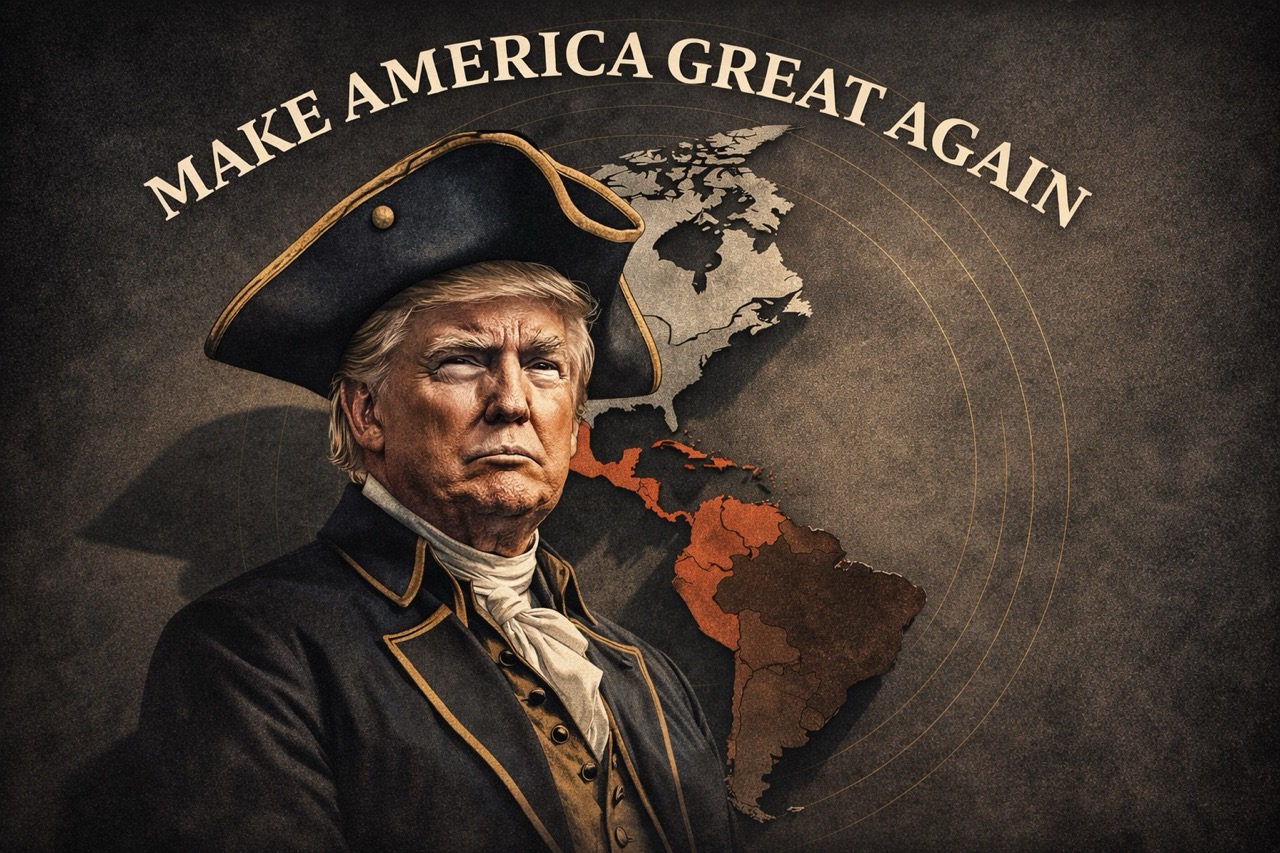
It’s not Venezuela.
It’s not Maduro.
And it’s not Trump, at least not in the way he is usually portrayed.
What we are witnessing is a Republic trying to save itself after the end of its imperial cycle. The Empire, in its true sense, is already dead. Trump is not trying to rebuild it. He is trying to preserve the Republic.
Those who keep reading these events like a football match — Trump yes, Trump no; USA good, USA bad — remain on the surface. This is not a moral or ideological question. It is a material one.
Trump does not act like an emperor. He does not export values, he does not build multilateral orders, and he does not speak the language of universal missions. He acts like a Republic under stress: an eroded industrial base, a debt system dependent on constant refinancing, and a strategic competition with China that cannot be won through rhetoric.
American re-industrialization is not a slogan. It is a matter of survival. Without low-cost energy, without raw materials, and without control over supply chains, there is no productive base. And without a productive base, even the financial system weakens.
It is within this framework that Latin America becomes central again. Not as a moral mission, but as vital space. The Monroe Doctrine has not been resurrected out of nostalgia; it has re-emerged because material conditions make it unavoidable.
In this context, Venezuela is not the subject of the story. It is a geopolitical lever, whose value lies not in its domestic politics, but in its energy role and in the signal it sends within a much broader competition.
There is, however, an element that clarifies the timing. On the very day of the operation, while the issue was still being framed externally as a local matter, a Chinese special envoy was present, engaged in high-level direct talks with Caracas. These were not routine contacts, but an explicit attempt at political and energy coordination. At that moment, Venezuela ceased to be an unstable lever and became a potential asset integrated into China’s strategic projection.
That passage marked the crossing of a threshold. Not for ideological reasons, but because it redefined space. The message is simple: China may grow and compete, but it cannot transform the Western Hemisphere into its own energy platform. This is not a frontal confrontation. It is a delimitation of space.
Those who interpret these choices as the result of external orders or ideological pressure — including obsessive “Zionist” readings — are operating on the wrong analytical plane. This is not about obedience. It is about structural necessity. When a Republic is constrained by systemic limits, it does not act according to preferences; it acts according to what is indispensable for its survival.
The real constraint is not diplomatic. It is financial. A system that depends on continuous debt refinancing requires control, stability, and guaranteed access to resources. Geopolitics is not separate from finance; it is its precondition.
In this scenario, even the European Union and NATO cease to be natural alliances and become structural constraints — costly, rigid, and unsuited to a phase of contraction. Dismantling them is neither madness nor betrayal; it is republican rationality in a post-imperial world.
A return to a continental logic is not historically anomalous. The American Republic fought wars within its own geographic space to consolidate territory, resources, and strategic depth long before it became a global power. Today it is doing something analogous, in a far more fragile and complex context.
If you think this story is about Trump as a person, you have already lost the thread.
If you think it is about Maduro, you never had it.
This is not a struggle between good and evil.
It is a Republic trying to survive after the end of Empire.
Republics do not collapse from a lack of strength,
but when they stop understanding the geopolitics that sustains them.